

The demand for “low-sugar,” “light,” or “keto” baking is unstoppable. Erythritol, xylitol, and stevia have become common ingredients not only in professional labs but in home pantries. And with them, a new wave of frustrations has arrived.
“Why is my cake dry?” “Why did my bake stay pale?” “Why do I taste a weird aftertaste and a gritty texture?”
The fundamental mistake is to think of sugar (sucrose) as a simple “sweetener.” The truth, from a chemical and technological standpoint, is that sweetness is perhaps its least important function.
In pastry, sugar is structure. It is preservation. It is water management. It is color (the Maillard reaction). It is “tenderness.” When we remove it, we aren’t just removing the sweet taste. We are removing the primary architect of our recipe.
Understanding the chemistry of what its substitutes don’t do is the first step to using them successfully.
Part 1: For the Home Baker (The Enlightened Practice)
For those experimenting at home, a 1:1 substitution of sugar with a sweetener is almost always a failure. Every substitute has its own chemical “personality” that we must get to know.
Sugar (Sucrose): The Moisture “Sponge”
Think of sugar as a magnet for water. It is hygroscopic: it attracts and holds onto moisture, keeping cakes tender and “moist” over time. Furthermore, it caramelizes and browns (Maillard reaction), giving color and aroma.
Erythritol: The “Crystalline” One That “Dries”
This is the most popular one. It’s a sugar alcohol (or polyol), but it has two key characteristics:
- It is not hygroscopic: It doesn’t hold water. In fact, it tends to “expel” it and recrystallize. This is why bakes with a lot of erythritol “dry out” quickly and can develop a “gritty” or “crunchy” texture.
- It doesn’t brown: It does not participate in the Maillard reaction. Your cakes will remain pale.
Xylitol: The “Cooling” Effect
Similar to erythritol, but with one advantage: it is more hygroscopic. It retains moisture better and is therefore preferable for tender cakes. However, it has a well-known “cooling effect” (an endothermic reaction) that can be pleasant in a cream but strange in a cookie.
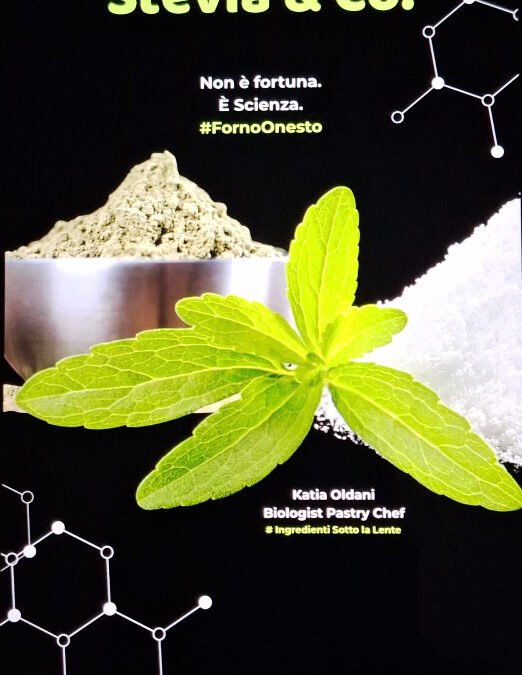
Stevia (Steviol Glycosides): Pure Sweetness (with Zero Bulk)
Stevia is incredibly sweet, but it has zero bulk. If the recipe calls for 200g of sugar, you cannot replace it with 2g of stevia. You’ve removed the sweet taste, but you’ve also removed 200g of solid mass that provided structure. The result will be a gummy or collapsed product.
The Advice Under the Lens: Stop substituting 1:1. If you use erythritol, you must compensate for the moisture loss (e.g., by adding fibers like inulin, or fats). If you use stevia, you must replace the missing bulk. “Without” baking is a pastry of balancing.
Part 2: For the Professional (The Technical Deep-Dive)
For the professional, “sugar-free bakery” is an exercise in formula re-engineering. We must replace the technological functions of sucrose.
Technological Functions of Sucrose:
- Water Binding: Sucrose lowers water activity (a_W), ensuring shelf-life (microbial control) and softness (moisture retention).
- Structure: It provides bulk and determines the viscosity of fluid batters. During baking, its crystallization/vitrification defines the texture (e.g., meringues, shortcrust).
- Maillard Reaction: Although sucrose is not a reducing sugar, acid inversion (into fructose and glucose, which are reducing) during baking allows the Maillard reaction. Direct caramelization occurs at high temperatures.
- Control of Protein Coagulation: It raises the coagulation temperature of egg proteins, allowing more air to be incorporated before the structure sets (essential for sponge cakes).
The Analysis of Polyols (Erythritol, Xylitol, Maltitol):
They are sugar alcohols. Their functionality varies enormously.
- Browning (Maillard): Being alcohols, they are not reducing sugars and do not participate in the Maillard reaction. This is the chemical reason for the pallor of the finished products.
- Water Binding: Erythritol is the least hygroscopic of the polyols; it tends to crystallize in anhydrous structures, “stealing” water from the product and drying it out. Xylitol and maltitol are much more hygroscopic and better suited for soft products, but they have a different impact on a_W.
- “Cooling” Effect: This is a negative endothermic heat of solution. Erythritol has the most marked effect (-43 cal/g), which must be masked or utilized.
Steviol Glycosides (Stevia) and the Use of Bulking Agents:
Stevia (and other high-intensity sweeteners like sucralose) only solves the taste. The challenge is structural. The lost bulk must be replaced with “structure,” usually soluble fibers (polydextrose, inulin, FOS). These fibers, in turn, have a powerful impact on water binding, often greater than that of sugar, risking a “gummy” product if not balanced with the fat component.
The Analysis Under the Lens: The solution is never a single ingredient. Successful “low-sugar” baking relies on synergistic systems. For example: a blend of Erythritol (for bulk and clean sweetness) + Inulin (to bind lost water and add structure) + a pinch of Stevia (to reach the desired sweetness peak without increasing bulk). It is a physico-chemical balance.
The Meeting Point
Alternative sweeteners are not “fake sugar.” They are technological ingredients with their own precise chemical ID card.
For the home baker, it’s the awareness that you cannot substitute 1:1; you must compensate for the lost functions (bulk, moisture) with other ingredients.
For the professional, it’s a fascinating exercise in formulation. You stop “replacing” and start “building” a new structure from scratch, using polyols, fibers, and high-intensity sweeteners as bricks.
In both cases, biology and chemistry free us from frustration and give us the tools to innovate with awareness.
With unchanging passion and science,
Katia Oldani
Biologist Pastry Chef
Click Here and Visit My YouTube Channel
For any information or to contact me CLICK HERE