

Welcome back to “Ingredients Under the Lens.” Today, we dive deep into the science of sourdough starter. We aren’t just analyzing a simple ingredient, but a complex and fascinating living ecosystem.
I am Katia Oldani, Biologist and Pastry Chef. For me, the sourdough starter (or Pasta Madre) is the beating heart of every great leavened product. Its performance—from the softness of the crumb to the complexity of the aroma—is entirely dictated by its microbiome: that symbiotic community of lactic acid bacteria and wild yeasts that ferment sugars and acidify the dough.
The science of sourdough presents us with the image of a perfect microbiome: an almost utopian balance where microbial strains work in absolute harmony to produce the ideal lactic acid and desired aromatic esters.
The Thesis: The real test isn’t found in textbook theory, but in the daily practice of the laboratory. The artisan’s challenge is not creating perfection, but maintaining it, fighting against the inevitable variables that constantly push the starter away from its ideal state.
To explore this fascinating gap, let’s place the Sourdough Starter at the center of a discussion that bridges field experience, theoretical knowledge, and sensory judgment.
1. The Challenge of Consistency: The Artisan’s Laboratory
Ask a professional baker what their ideal sourdough starter is, and the answer won’t be about chemical formulas, but about performance consistency.
The Artisan Ideal: Strength and Sweetness
An artisan seeks a starter that is primarily strong (doubling its volume in precise times, often 3-4 hours at 28°C), but above all sweet. By “sweet,” we mean a starter with a very low perception of pungent acetic acidity.
Scientifically, this “sweetness” translates into a management style that promotes homolactic fermentation. This pathway produces almost exclusively Lactic Acid (C3H6O3). We aim for a Lactic/Acetic ratio (L/A) greater than 10. Lactic acid is a formidable ally: it provides elasticity to the gluten network and acts as a natural preservative.
Lab Difficulties: When the Microbiome Fights Back
In practice, however, the starter is in constant danger. The variables undermining this perfection include:
-
Changing Flour Characteristics: Every batch of flour has a different enzymatic and protein content. If the microbiome isn’t fast enough in producing the necessary acids, the flour’s enzymes (Proteases and Amylases) can take over, degrading the starch and gluten too aggressively. The result? A “slack” starter with no structure, leading to a final dough that collapses or becomes gummy.
-
Thermal Instability: In a large laboratory, temperatures fluctuate. A sudden drop at night can favor heterofermentative bacteria, which produce more Acetic Acid (CH3COOH). The starter becomes acidic, smells like vinegar, and requires a laborious cycle of “washing” (bagnetto) and refreshments to restore balance.
The Practical Result: The artisan doesn’t work with a perfect microbiome, but a manageable microbiome. The art lies in anticipating deviations and using the science of sourdough (altering hydration or temperature) as a lever to force the microbial community back to that ideal L/A ratio > 10.
2. Biological Balance: The Perspective of the Biologist
The eye of the student and the biologist is focused on microbial function and the strict control of environmental parameters.
The Theoretical Ideal: Symbiosis and Selection
Theory teaches us the magic of mutualistic symbiosis between the main actors: Yeasts (e.g., Candida milleri) which produce carbon dioxide and alcohol, and Lactic Acid Bacteria (LAB) (e.g., Lactobacillus sanfranciscensis) which produce organic acids.
The “perfect” microbiome is one with low species diversity but a high density of specific strains that coexist without destructive competition.
Lab Difficulties: Competition and pH Control
In reality, sourdough is an open system. Every refreshment is a potential entry point for unwanted strains. The real difficulty is biological selection, which depends on precise environmental parameters.
Temperature Control: The goal is a high temperature, around 29°C (84°F), to favor a high L/A ratio. The practical risk is that a temperature drop will favor unwanted acetic acid production.
Hydration Control: Low to medium hydration (e.g., Stiff Sourdough or Pasta Madre) is preferred for strength. The risk is that excess water can dilute protective acids and stress the bacteria, altering osmotic balance.
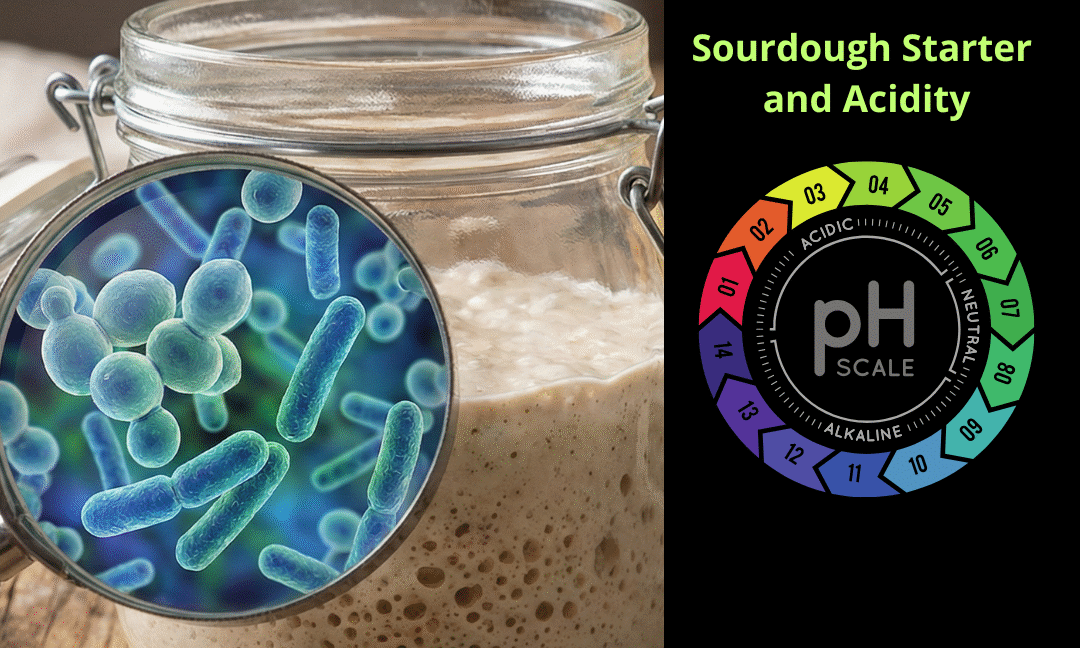
Final pH Control: The ideal maturation pH is between 3.9 and 4.1. If the pH drops below 3.8, the acidity is excessive and damages the gluten mesh. If it rises above 4.2, the yeast is weak, unstable, and prone to contamination.
The Practical Result: The pH level is not just a number: it is the barometer of the microbiome’s health. The difficulty lies in the fact that pH doesn’t tell us which acids are present. A starter might have a perfect pH (4.0) but an unbalanced flavor profile (too acetic). The biologist must, therefore, combine pH measurement with sensory analysis to understand which metabolic route has been taken.
3. Sensory Judgment: The Enthusiast’s Perspective
Finally, the lover of great leavened products (like Panettone) is our final judge. Their perception is the proof that the microbiome has either failed or triumphed.
The Sensory Ideal: Softness and Complexity
The enthusiast seeks: an airy structure (softness that melts in the mouth, with elongated and regular alveoli) and a persistent aroma (clean notes of butter, vanilla, and citrus, without unpleasant odors).
The Revealed Difficulty: Defects that Expose Errors
The defects that the enthusiast detects are the fingerprints left by an imperfect microbiome:
-
Vinegary and Pungent Taste: Signals an excess of acetic acid, a clear failure to maintain a high L/A ratio. Usually caused by management at temperatures that are too low.
-
Gummy or “Hard” Crumb: Indicates excessive protease activity or a final pH that was too low, stiffening the gluten network. The dough fails to “breathe.”
-
“Flat” or Insipid Aroma: This is the most subtle defect. The yeast produced CO2 and acids, but not the volatile secondary compounds (Aromatic Esters). These are produced by specific lactic acid bacteria under optimal conditions and are the true difference between a good Panettone and a masterpiece.
The Practical Result: The enthusiast teaches us that it is not enough for the starter to simply “rise.” It must enhance the flavor of the dough. The perfect microbiome is, first and foremost, a factory of complex natural aromas.
Understanding to Improve
The perfect microbiome is a state of grace that is extremely fragile. It is not a finish line, but a constant dynamic equilibrium that the artisan must chase daily.
Biology and pastry arts merge here:
-
Understanding the Science: Measuring temperature and pH gives us objective data.
-
Applying the Art: Experience teaches us to translate that data into immediate actions (changing hydration, temperature, or refreshment frequency) to bring the ecosystem back to the ideal.
Only with full awareness of the variables acting on the microbiome can the Artisan transform the science of sourdough starter into a sublime sensory reality.
Expert Tip: How to Correct Excess Acetic Acidity
After analyzing the ideal and the practice, let’s conclude with one of the most common challenges in the lab: a sourdough starter that becomes excessively acetic, with a pungent smell that risks compromising the flavor profile of your final product.
This defect signals that our microbiome is unbalanced, favoring acetic acid production over lactic acid (the L/A ratio has dropped). We must “reprogram” our lactic bacteria to return to homolactic fermentation.
The 3-Step Correction Protocol
To restore the microbiome to the desired balance where lactic fermentation prevails, we must act on the two most powerful environmental parameters: temperature and hydration.
-
Increase Refreshment Temperature: Instead of refreshing at lower temperatures (24°C or 26°C), bring your proofing chamber or resting environment to 28°C – 29°C (82°F – 84°F). Warmer temperatures tend to inhibit heterofermentative bacteria (acetic producers) and favor the growth of homolactic lactobacilli, which work in a “cleaner” way.
-
Slightly Increase Hydration: Add 2 or 3 percentage points of water compared to your usual management. If you use 45% water on flour weight, try 47% or 48%. The additional water acts as a “diluent” for excess acids and helps slightly oxygenate the dough during mixing, a factor that stresses yeasts less and stabilizes the environment.
-
Repeated Refreshment Cycles: Perform 3 or 4 consecutive refreshments following this regime (high temperature and slight extra hydration). It is crucial that you refresh the starter every time it reaches its maximum development, but before it starts to collapse.
Observe the smell: when the starter returns to a clean, milky, and pleasant scent—a sign that the microbiome has restored the correct L/A ratio—you can return to your standard management.
With Passion and Rigor,
Katia Oldani
Biologist Pastry Chef
Click here to Visit my YouTube Channel
For any information or contact CLICK HERE