

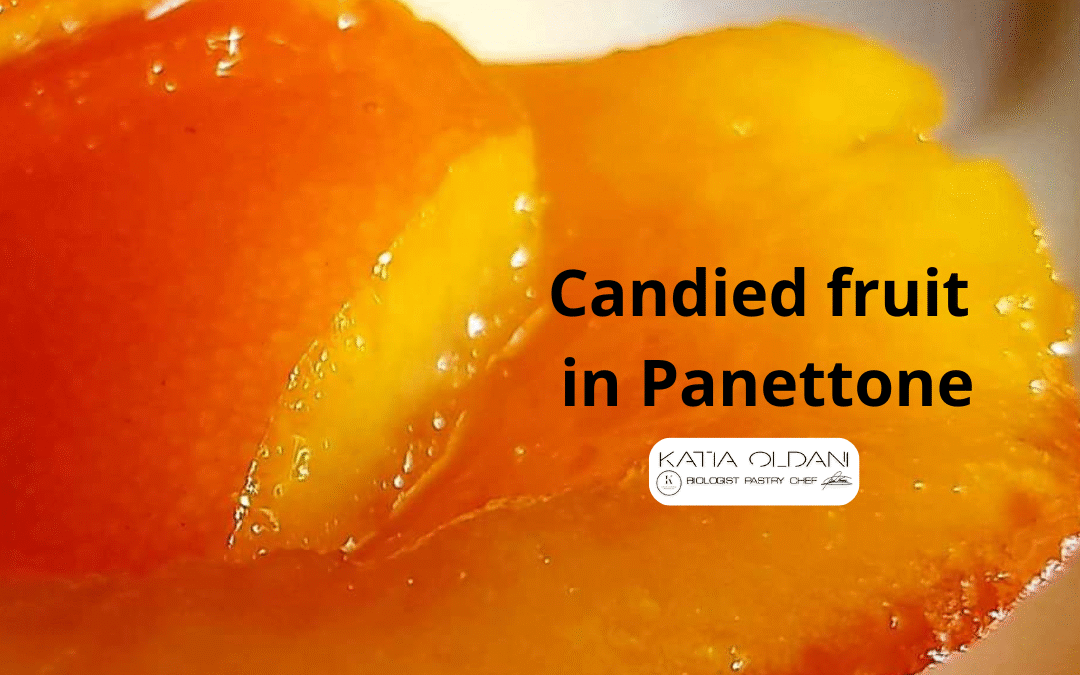
December brings with it the great Italian dilemma: let’s talk about candied fruit in Panettone. Is it better with or without? Often, this ingredient is discarded out of prejudice, perhaps due to past experiences with industrial products where cloying sweetness overpowered the aromatic profile.
However, reducing candied fruit to a simple “chunk of sugar” is a misjudgment. In the great art of baking, candied fruit is not just a decoration or a matter of personal taste: it is a structural pillar that guarantees the technical success and shelf-life of the product. Today, for our column Ingredients Under the Microscope, we discover the science hidden inside that little orange cube.
Candied fruit in Panettone: the art of preservation via osmosis
To understand the importance of candied fruit in Panettone, we must start with technique. Candying is technically a method of preservation by “substitution”. Through a slow process that respects the raw material, the free water contained in the fruit is progressively replaced by a sugar solution.
This happens due to a well-known physical principle: osmosis. By immersing the fruit in syrups of increasing concentration (measured in degrees Brix), water migrates outwards and sugar penetrates the plant cells. The result is a pulp that maintains its structural turgidity but becomes a hostile environment for bacterial proliferation, ensuring preservation without the use of aggressive preservatives.
Hygroscopic equilibrium and the Aw parameter
It is precisely this substitution process that generates the most important technical value, making it irreplaceable compared to other forms of fruit. Everything revolves around Water Activity (Aw), a parameter that indicates the “free” water available for chemical reactions.
Why doesn’t a master pastry chef use fresh or dried fruit?
-
Fresh fruit possesses an Aw that is too high (about 0.98): once in the oven, it would release uncontrolled water, creating mold within a few days.
-
Conversely, dried fruit (Aw 0.50-0.60) would tend to rehydrate by stealing moisture from the Panettone crumb, drying it out prematurely.
Artisanal candied fruit, on the other hand, reaches an Aw of approximately 0.70-0.75, a value almost identical to that of a baked artisanal Panettone. This creates a perfect hygroscopic equilibrium: the candied fruit does not release excess moisture nor does it steal it from the dough. This is why true candied fruit in Panettone acts as a “buffer,” stabilizing internal humidity and slowing down the staling of the cake over time.
Recognizing quality: Transparency and Texture
When a candied fruit is made respecting these physical principles, the difference is tangible even for the less experienced consumer:
-
Translucency: The sugar, penetrating perfectly, modifies the refractive index of the pulp, making it look like a translucent and brilliant gem, not opaque.
-
Peel vs. Pulp: In a high-quality candied fruit (such as a Washington Orange or a Diamante Citron), one can distinctly perceive the difference in texture between the white part (albedo) and the zest rich in essential oils.
-
Absence of crystallization: The wise use of glucose syrup in combination with sucrose prevents the sugar from recrystallizing, ensuring a soft and melting bite, never “sandy”.
Conclusion
Candied fruit is therefore not an enemy to be discarded, but a technological ally that works silently to keep the leavened product soft and fragrant.
Of course, for the pastry chef, it represents a significant challenge: its cubic shape and sharp edges put the gluten network to the test during the kneading phase… but that is a story of mechanics that we will tell you in the next episode. For now, enjoy the chemistry of taste.
With Passion and Precision,
Katia Oldani Biologist Pastry Chef
Click here to Visit my YouTube Channel
For any information or contact CLICK HERE