

Ingredients Under the Lens | Deep Dive
What does salt really do in dough? If you think it’s just for taste, you’re missing the most fascinating part. In pastry, and especially in baking, Sodium Chloride (NaCl) is a critical technological ally.
Dough without salt (or with the wrong dosage) won’t just be “bland.” It will be a structural disaster: collapsed, sticky, with out-of-control fermentation and a shorter shelf life.
Whether you’re a professional seeking total control or a passionate enthusiast who wants to stop “eyeballing it,” this article explains the chemistry and biotechnology behind that pinch of salt.
1. Salt and Gluten: The Secret to a Strong Structure
Salt’s first and most important function is structural. Salt strengthens the gluten matrix.
Without getting too deep into the chemistry, here’s what happens: gluten proteins have electrical charges that make them slightly repel each other. The salt ions (Na⊕ and ClΘ) “shield” these charges, allowing the protein chains to bind more tightly and in a more organized way.
In practice:
- The dough becomes stronger, more tenacious, and elastic.
- It withstands mixing (in a stand mixer) better without “breaking down.”
- It retains fermentation gases (CO²) more effectively, leading to a final product with greater volume and a more regular, silky crumb.
Salt-free dough is weak, relaxes too quickly, and “gives up,” resulting in a flat loaf after baking.
2. Salt and Yeast: How to Control Fermentation
This is the question everyone asks: “Does salt kill yeast?” The answer is: it controls it.
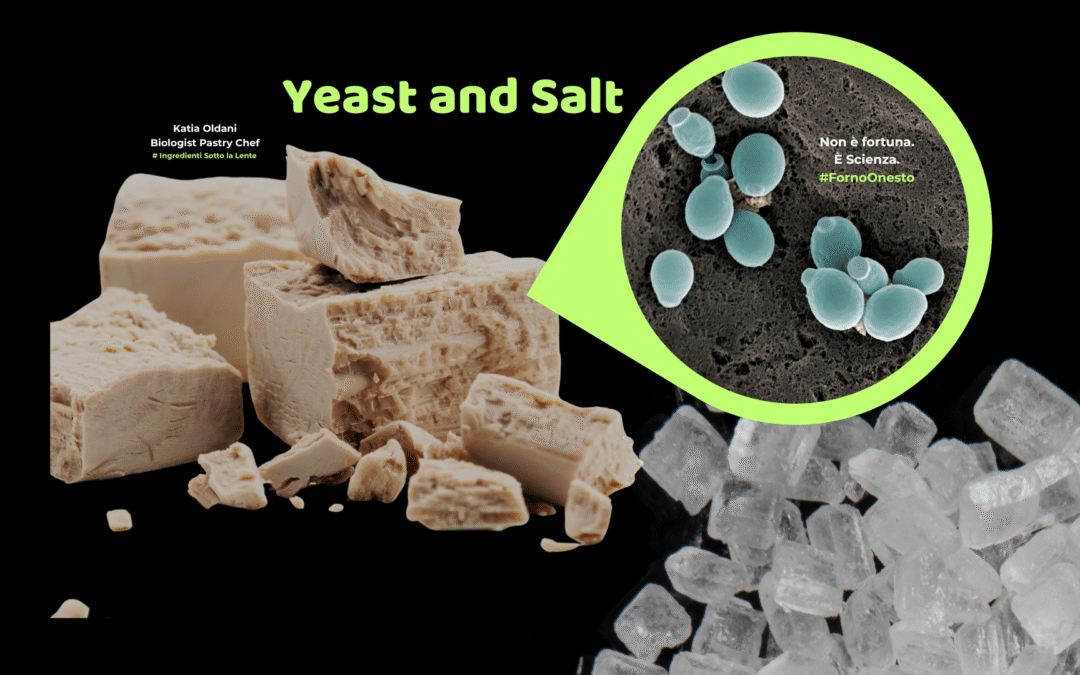
Salt acts on the activity of yeast (Saccharomyces cerevisiae) through osmotic pressure. By being hygroscopic, salt “steals” the free water in the dough, making it less available to the yeast cells.
For the yeast, this means the environment is more “stressful”: it has to work harder to absorb the water and nutrients it needs. The result? All fermentation activity slows down.
This is not a bad thing; in fact, it’s essential. This slowing action (braking effect) allows for:
- Correct proofing times (bulk and final proof), preventing a rapid fermentation that leads to collapse.
- Better flavor development, giving enzymes time to create more complex aromatic precursors.
This is why, in many doughs, salt is added in the middle or at the end of mixing: to give the yeast time to “get started” before “hitting the brakes.”
3. The Dough Guardian: Salt vs. Enzymes (Protease)
In long fermentations (like biga, poolish, sourdough, or 24/48-hour doughs), salt plays the role of a “guardian” for the structure.
Flour contains enzymes called protease, whose job is to break down proteins. If left unchecked, these enzymes degrade the gluten network, a process called proteolysis. The result? A dough that becomes sticky, slack, overly extensible, and unable to hold its shape.
Salt acts as a mild inhibitor of this enzymatic activity. It protects the gluten during the long hours of maturation, ensuring the dough arrives at baking time still strong and high-performing.
4. Flavor Enhancer: Balancing Sweet and Bitter
Obviously, salt adds flavor. But its sensory role is far more sophisticated, especially in pastry.
Salt is a flavor enhancer: it doesn’t just “make things salty,” it amplifies other tastes.
- In Desserts: The classic “pinch of salt” in a shortcrust, custard, or ganache isn’t to make it salty, but to enhance the perception of sweetness.
- In Chocolate: It’s essential. Salt has the chemical ability to lower our perception of bitterness. This is why a pinch of salt makes dark chocolate, caramel, or coffee feel “rounder,” more complex, and less “aggressive.”
It removes the “flat” or cloying note, providing a three-dimensional aromatic profile.
5. A Natural Preservative: Water Activity (a_w)
Finally, salt is a powerful natural preservative. It does this, once again, by managing water.
The scientific parameter that measures a food’s perishability is Water Activity (or a_w). It doesn’t indicate how much water is present, but how much water is free* and available for microbial proliferation (mold, bacteria).
By binding to water, salt drastically lowers the a_w of the dough and the finished product. This means:
- Greater microbiological safety.
- Prolonged shelf-life (the product lasts longer).
- Slowing of staling (though this is a more complex process tied to starch retrogradation).
In Conclusion: Salt Isn’t an Opinion
From gluten to yeast, from enzymes to taste, salt is a multifunctional technological ingredient. Understanding how and when to use it is the first step from simply “following a recipe” to “mastering a dough.”
With unchanged passion and science,
Katia Oldani Biologist Pastry Chef
Click Here and Visit My YouTube Channel
For any information or to get in touch CLICK HERE