

Hello everyone, and welcome.
In pastry, nothing is left to chance. The softness of a cake, the texture of a loaf, the structure of a meringue—these are not happy accidents. They are the result of invisible engineering, a precise blueprint where every ingredient plays a defined role that goes far beyond flavor.
Today, we’re putting two of the most powerful and often underestimated structural agents under the microscope: sugar and air.
Forget the idea of sugar as a simple sweetener. In this analysis, we will treat it for what it truly is: a mechanical tool, a chemical stabilizer, and a thermal regulator. Air, for its part, is not an abstract entity, but the primary construction material that provides volume and texture.
As a Biologist Pastry Chef, my mission is to give you the tools to move from merely following a recipe to designing it with purpose. We will analyze the interaction between sugar and air not as a generic “secret,” but as a precise physical and chemical mechanism. Shall we begin?
Phase 1: The Mechanics of Creaming – Building Structure in Fat
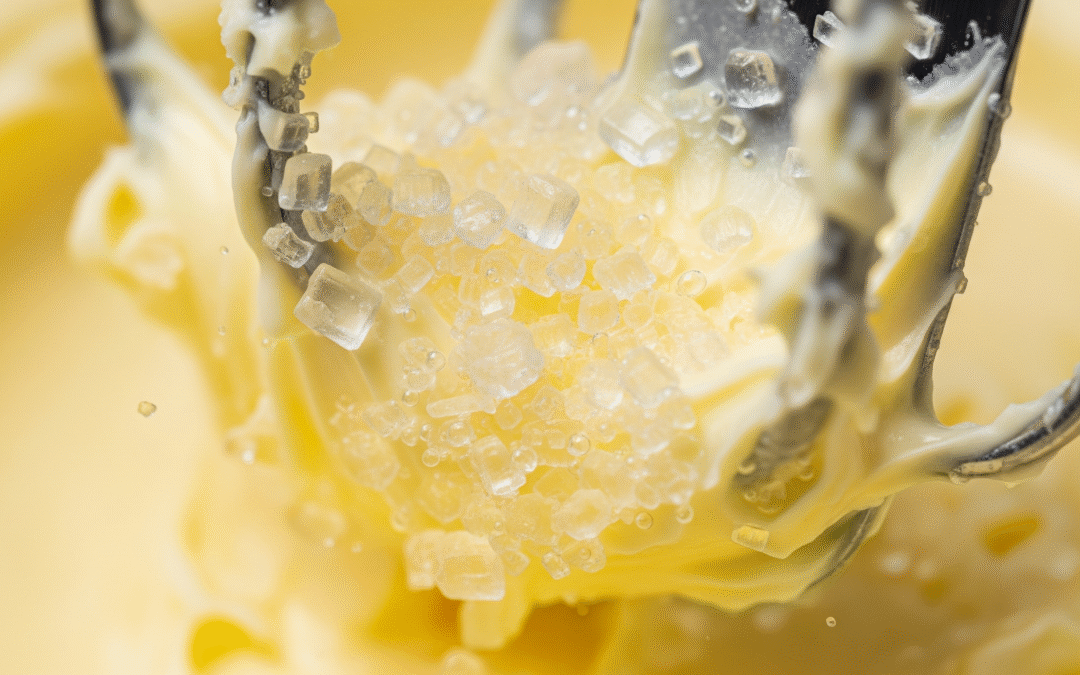
When a recipe begins with “cream the butter and sugar,” it’s asking you to perform a true feat of engineering. You are building the skeleton of your dessert by creating a two-phase system: a continuous fat phase and a dispersed gas phase. This process is a pure application of mechanical force.
Sugar as a Processing Tool
Imagine sugar crystals not as an ingredient to be dissolved, but as a technical abrasive. Their role is purely physical:
- Creating Gas Nuclei: The sharp edges of the crystals act through friction and incision on the plastic mass of the butter. This mechanical action generates countless micro-cavities, or “nucleation sites,” where air is forcibly trapped.
- Forming the Lipid Network: Butter, which is itself an emulsion of water in fat, when at the correct temperature, allows its fat globules to deform around these air bubbles, stabilizing them. The increase in volume and the change in color to a pale ivory are the visible evidence of this solid-gas emulsion being created.
The Critical Variables of the Process
- Fat Plasticity (The Operating Condition): The butter’s temperature is crucial. It must be able to deform without fracturing (if too cold) or collapsing (if too warm). The optimal range, approximately 16-19°C (61-66°F), allows for maximum efficiency in incorporating and retaining air cells.
- Sugar Granulometry (Defining the Texture): The size of the crystals is directly proportional to the size of the air cells. Caster sugar (or extra-fine sugar), with its small, uniform crystals, produces a network of dense, even micro-bubbles. This translates into a fine, tight crumb. Coarser sugar creates fewer nucleation sites, resulting in larger, more irregular bubbles.
- Processing Dynamics (Energy Efficiency): A medium, sustained speed optimizes the transfer of mechanical energy into the system, promoting the formation of small, stable bubbles. Excessive speed (over-creaming) introduces too much heat from friction, breaking the lipid network, causing the bubbles to merge (coalesce), and compromising the final structure.
🔬 Process Diagnostics: Signs of structural failure in creaming. A mixture that becomes shiny and loses volume is undergoing phase separation. The fat can no longer hold the air; the bubbles are collapsing. This process is irreversible and will result in a partial collapse of the structure in the oven.
Phase 2: The Art of Foaming – Weaving Elastic Protein Webs
When we whip eggs with sugar, the scene changes completely. Here, the protagonists are the proteins (mainly albumin and ovalbumin), which are capable of unfolding and reorganizing to create a foam. Sugar intervenes as a strategic partner, stabilizing and perfecting this structure.
The Three Superpowers of Sugar in Foaming
- Hygroscopic Power (The Moisturizer): Sugar loves water. By drawing water molecules from the eggs, it creates a dense micro-syrup. This syrup coats the proteins, protects them from excessive denaturation, and makes the walls of the air bubbles thicker, more flexible, and more resistant.
- Viscosifying Power (The Stabilizer): By increasing the liquid’s viscosity, sugar slows the drainage of water from between the bubbles. This prevents the foam from collapsing prematurely, giving us more time to incorporate other ingredients.
- Thermal Power (The Regulator): During baking, sugar raises the temperature at which egg proteins coagulate. This is critical: it allows the air bubbles to expand to their maximum volume from the oven’s heat before the structure permanently “sets,” ensuring exceptional volume.
A Masterful Example: The Three Paths of Meringue
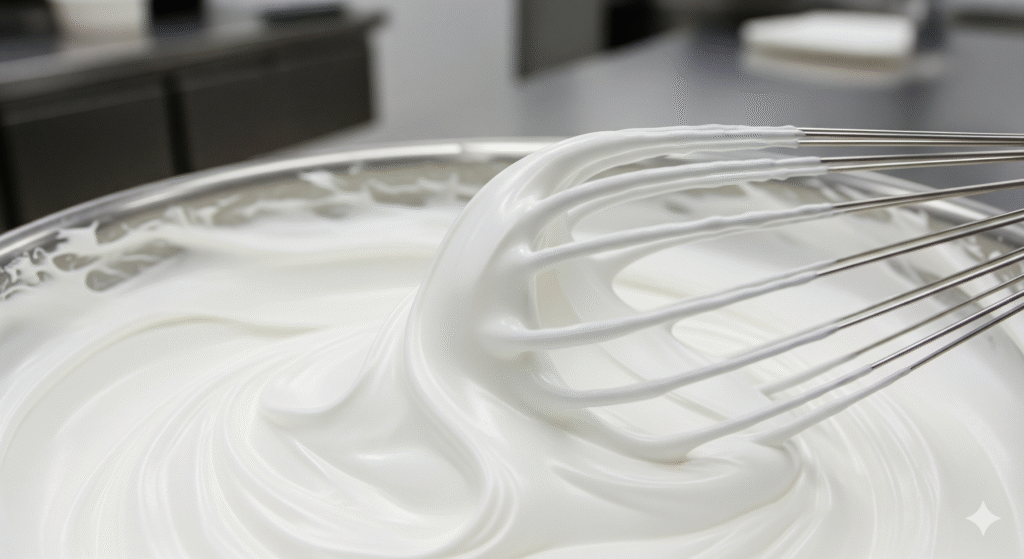
Stiffly beaten meringue, an example of optimal foaming where sugar stabilizes egg proteins, creating a shiny and resistant structure.
The “when” and “how” sugar is added defines the very structure of a meringue:
- French Meringue: Sugar is gradually added to already foamy egg whites. It’s quick to whip and has great volume, but is the least stable.
- Swiss Meringue: Egg whites and sugar are heated together over a double boiler (bain-marie) before whipping. The sugar dissolves completely, creating a very fine, glossy, and stable foam.
- Italian Meringue: A hot sugar syrup is poured in a thin stream into whipping egg whites. This is the most stable and hygienically safe meringue, as the heat from the syrup partially pasteurizes the whites.
The Grand Finale: From Air to Solid Structure in the Oven
The thousands of bubbles we painstakingly created during creaming and foaming are merely the blueprint. The oven is the construction site where this blueprint becomes reality.
The pre-existing air bubbles are the expansion chambers. In the heat of the oven, the water in the batter turns to steam, and the gases produced by leavening agents (like baking powder) expand, inflating these chambers.
If our initial aeration is rich with small, dense bubbles, the expansion will be uniform and controlled, resulting in a fine, even crumb.
If, on the other hand, we have only a few large, unstable bubbles, the gases will inflate them unevenly, creating a coarse crumb or, worse, causing the structure to collapse.
In this final phase, the flour (with its starch and gluten) acts as the “cement,” solidifying around these expanded air chambers to create the permanent structure of the dessert.
Conclusion: Become the Architects of Lightness
The next time you turn on your stand mixer, remember: you are not just mixing. You are designing. You are insufflating air and using sugar as a tool to build the structure of your dessert, millimeter by millimeter.
Understanding this dance between physics and chemistry frees you from the tyranny of the recipe. It allows you to diagnose a problem, adapt a procedure, and, above all, create with a new and deeper awareness.
Experiment, watch your batters change color and volume, and be proud of every single air bubble you have created. You are now the architects of lightness.
With passion and science,
Katia Oldani
Biologist Pastry Chef
Click Here to Visit My YouTube Channel
For any information or to get in touch, CLICK HERE